 Campfire
The man who hired me into one of my more recent jobs opened the interview with a question I’ve never quite managed to forget: why did I want a job I was clearly overqualified for?
I don’t remember my answer word for word. I do remember thinking it was a perfectly fair question, if you read a CV the way most companies draw their org chart… with management sat on the top and everything else somewhere underneath it.
The ladder most places draw
You’ll know the shape. Junior, mid, senior, maybe a lead if you’re lucky, and then the engineering rungs just sort of stop. Anything above that has “manager” or “head of” in the title, so the only way to keep going up is to stop doing the thing that got you there in the first place. Plenty of very good engineers take that step because it’s the only step on offer, and some of them find they love it, and some of them find out a year later that they’ve swapped a job they were brilliant at for one they never wanted (the Peter principle, more or less, with a pay rise to soften the landing).
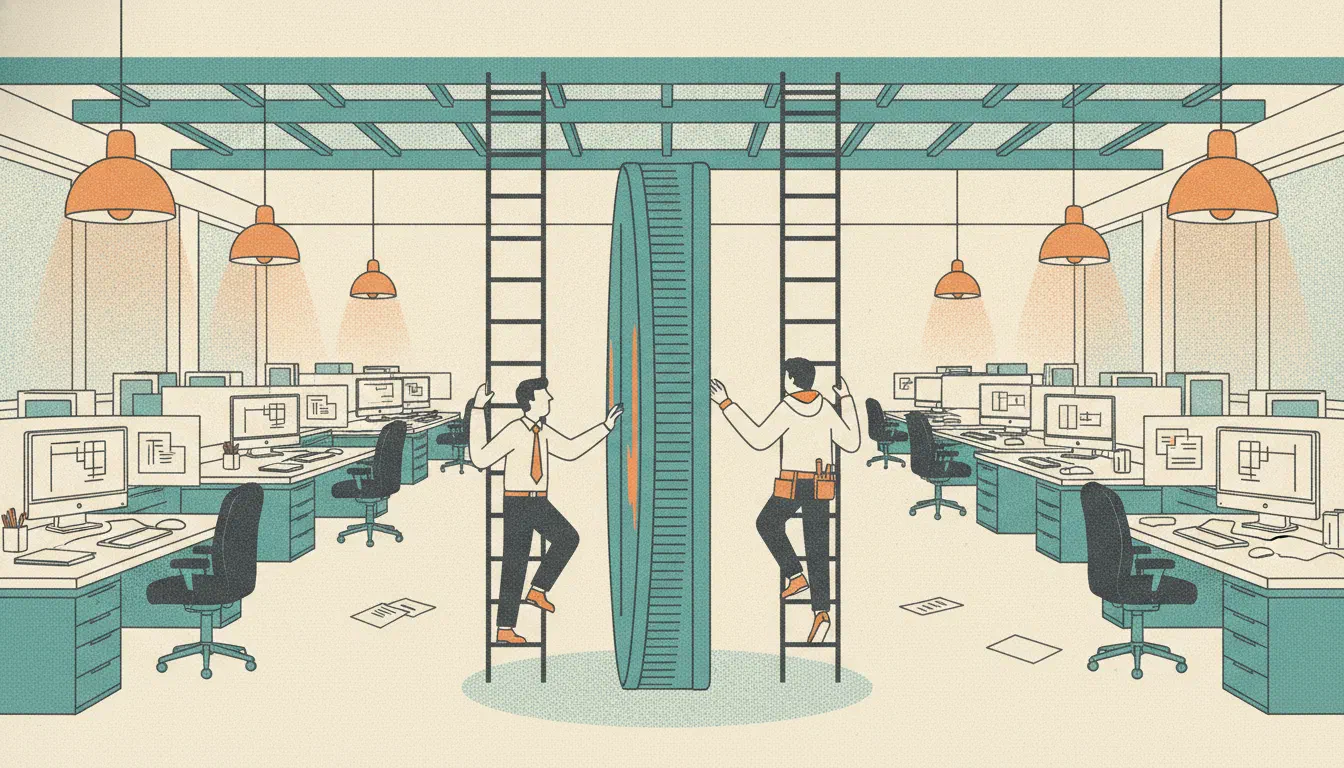
I don’t think management is the villain in that story. It’s a proper job, and a hard one, and I’ve done enough of it to know it has burdens the engineering side never sees. My problem is with the drawing. Management and engineering are two sides of the same coin, and far too many companies prioritise the management track and simply forget there’s no cap on the engineering one. Management is a choice. It was never a promotion.
The cap I built myself
The first time I hit that ceiling, the daft thing is I’d put it there myself.
I started my own boutique digital agency, Zucchi, and became its MD, which was a choice and a big one. It also pushed me about as far away from engineering as I’ve ever been and flooded my brain with management problems. It turns out being MD of a small company is mostly sales and HR, with a bit of engineering squeezed in round the edges if you’re lucky, and (as I’ve written about before) while I like to think I’m a decent engineer, I’m a shit salesman.
What I learned there wasn’t that management is bad. I was good at a lot of it! It was that the two jobs pull in different directions, and trying to be both at once, in one role, is a very hard thing to reconcile. The top of the only ladder in the company was a job I’d never have applied for… and I’d drawn that ladder myself.
A channel, not a waiting room
Every company where I’ve had any say since, I’ve pushed for a fully fledged engineering channel, so people can keep growing without being shoved into management to do it. The titles varied from company to company, but the point was always the same: a way up that doesn’t go through a management role.
And that’s also where I learned the other half of the problem, which is that everybody chases the title. I find this massively frustrating. We’d take on graduates straight out of university as juniors, and within twelve to twenty-four months a fair few of them would either be declaring they should be made senior, or leaving for somewhere that would hand them the word, as if the engineering track was a quick route up just by turning up for long enough.
That properly incensed me. Growth should be something you can show, from the effort you put in and the value you bring to the team, and time served is neither of those. A track with no cap isn’t a waiting room where the titles come round on a timer. It needs the rungs written down, so that everyone (the engineer, their lead, the person signing off the pay rise) can point at what senior actually means and see whether you’re doing it.
What it looks like done properly
Since then I’ve gone looking for companies that write that combination of effort and value down, and Axon did it really well. Their engineering ladder didn’t stop at senior. It carried on past Senior Software Engineer II to Staff Engineer, then Principal, then Distinguished Engineer, three more rungs past the point where a lot of companies simply run out of ladder, and each one had its expectations written down and sat level with a role on the management side, all the way up to just under the C-suite. An engineer there could keep climbing for a whole career without ever having to manage anybody.
Axon is where I was asked that interview question, as it happens, and I took the job on the engineering side of the coin, on purpose. Years of running teams didn’t make it a step down, whatever the CV looked like from the outside. (For the record I sat a rung lower than the work I was actually doing, which was more like the two above it. A ladder can be beautifully drawn and still be read wrong.)
Same number on both sides
Now, the man who asked me that question was one of Axon’s longest-serving infrastructure engineers, a seriously skilled one with a whole career of it behind him, and somewhere along the way management had been thrust upon him rather than chosen. He was damn good at it, too. He took all that engineering and turned it into real engineering management. He could handle a room full of stakeholders, he knew what a team could actually carry, and he knew when a deadline was nonsense, because he’d been the one at the keyboard for most of his working life.
He got scapegoated anyway, more than once, for problems that were really about a small team being handed a big job without the people to do it, and eventually he switched back to the engineering track. Everyone around him treated it as a demotion.
What still makes me laugh (in a slightly hollow way) is that on paper it wasn’t one. He’d been a manager at one level, and he went back to being an engineer at exactly the same level. Same number on both sides. By the company’s own ladder it was a sideways step, a coin turned over… and the people around him read it as a fall anyway, because they wanted to.
So even a really well-written ladder isn’t proof against people. Axon had about the best engineering path I’ve worked inside, and folk were still able to bend it to suit their own agendas… writing the rungs down is necessary, it just doesn’t stop anyone reading them upside down.
He asked me, all those months earlier, why I wanted a job I was clearly overqualified for. I’d just picked which side of the coin I wanted facing up.
He’s since picked neither. His years at Axon paid off rather nicely in the end, and he’s taken early retirement, so as far as I’m concerned the last laugh is his… even if it does mean the industry lost a fantastic engineer and an exceptional manager in one go. Turns out you can land the coin on its edge after all.