 Campfire
I found out second-hand, which is how you find out most things about a place once you’ve left it. The platform my old R&D team had been building, the tooling that was going to carry a hundred-odd engineers off a PHP monolith and onto Go services… scrapped. They’d decided to keep the monolith.
That one stung, and I’d love to tell you all of the sting was aimed at whoever made the call. Some of it was (I’m only human). But the longer I chewed on it, the more of it kept pointing back at me…
A team made of other people’s speed
For a while I was chief architect over that hundred-odd engineers, plus all the BAs, QA and project managers you pick up with a department that size. Off to one side sat a small R&D team, and their job was the long game. They were building the platform tooling and the components that would let every team make the jump from monolith to microservices without each of them having to work out how on their own. And they were a great team, all good at different things and balanced in their opinions, which is rarer than you’d think in a room full of engineers (I’ve been in plenty of the other kind).
The trouble was the shape of what they made. Everyone else’s work had a trajectory you could draw: a feature this sprint, a fix the next, a nice line on a chart heading up and to the right. Theirs was a long slog designed to make all of those other lines steeper, eventually, and “eventually” doesn’t fit very well in a column on a weekly report. So the only place their work was ever going to show up was in other people’s numbers, reported by other teams.
The progress photos
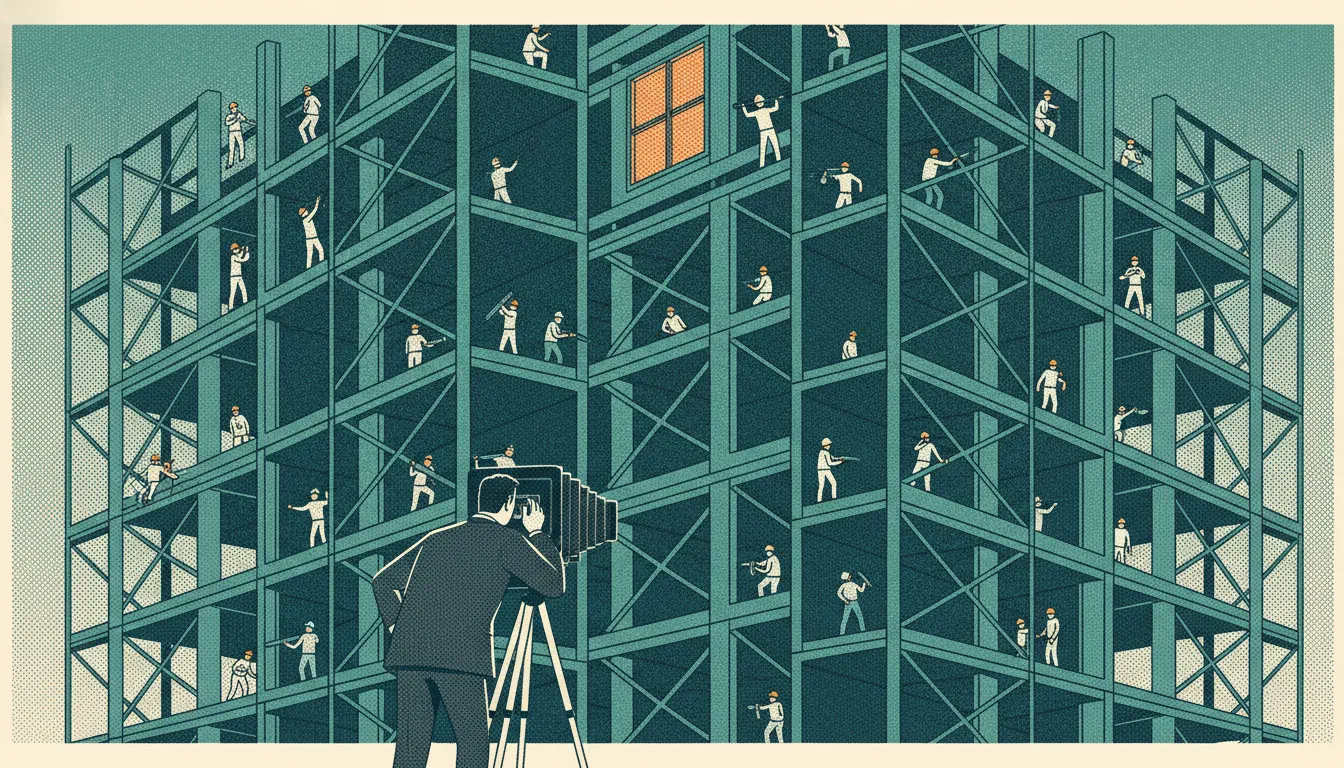
Picture a building site for a second. The progress photos are all of the building, aren’t they? The walls going up, the floors going in, the roof finally on. The scaffolding is in every single one of those photos and you don’t look at it once. It costs money every week it stays up, it isn’t the thing anybody ordered, and when the budget gets tight it’s the most obvious thing on site to take down… until you notice that nothing else goes up without it.
That was my R&D team. Then delivery became the name of the game, and they went, along with a large swathe of the wider department. A few teams had only just started onboarding onto the new tooling, and that was about all the evidence there ever was. It turned up just about as late as it possibly could have.
Now, if you’ve spent any time anywhere near a promotion ladder you’ve probably come across Tanya Reilly’s Being Glue, about the work that holds a team together and never shows up where anyone’s counting. The conversation that’s grown up around it tends to land on the frameworks: the ladders and the reports measure what’s in the diff, so they miss the connective stuff, so what you need is a better framework. There’s a lot of truth in that, and I’d quite like it to be where my version of the story ends.
I’d like to blame the report
Believe me, I’ve tried. It just won’t stick.
What I saw as obvious value wasn’t obvious to anyone else. To me it was plain as day that tooling which made a hundred engineers faster would pay for itself many times over. To the people deciding where the money went, it was a team with no line on the chart, and they were looking at the chart because the chart was what they’d been given. I was about the only person in a position to give them something else. Turning “this will make the whole department faster” into a number the business already cared about was my job, and I didn’t do it.
I think I’d assumed the value would speak for itself once enough teams were on the platform, and maybe it would have, given another year or so. But “it’ll be obvious later” is more of a hope than a case, and a hope is a very easy thing to cut when someone’s going down a spreadsheet with a red pen.
The exit cuts both ways
I wasn’t there for the consultations. My own role was safe, and I left before they started, for reasons I’ve written about before and won’t drag back out here.
I’ve turned that exit over a fair bit since, and I keep landing on two things at once. It was the only time anybody put a price on what that team was worth: I wasn’t going to stay and preside over their redundancy, and I walked away from whatever the payout would have been rather than do it. And it was also the last step of the same failure, because the person best placed to see what they were doing, and might still have made the case for them, had walked out of the building by the time it mattered most.
I’ve stopped trying to pick between those two. They’re both true, and I suspect they’ll stay that way.
One finished room
So, given my time again, I’d split the team’s effort into two streams.
The first would be what we already had. Build the platform and the components for the whole department, the long slog, the scaffolding.
The second is what I was missing. Pick a handful of systems that are really hurting and would benefit directly from the new tooling, and measure what the monolith is costing you there before you touch anything. Then rebuild them on the platform, even though it isn’t finished, and accept you’ll be backporting changes into them each time the platform shifts underneath. Then measure again. On paper the backporting looks like waste, doing the same work twice over. In practice it’s what the evidence costs, and I’d pay it happily now!
I’d be choosy about where I pointed it, too. Customer-facing first, mostly page load and responsiveness, because that’s something stakeholders can see and get excited about, in numbers they already watch. And I’d steer well clear of the checkout, or the ERP and logistics tooling round the back… if the proving stream falls flat on its face, you want it to fall somewhere cheap.
That second stream is one finished room you can walk a stakeholder into. Same scaffolding, same half-built building, but a room with the lights on and a number on the door saying how much faster it is than the old one.
We kept putting up scaffolding instead, and we did it well. They took it down and kept the old building, and I’d still back ours as the better one, though I’m the reason nobody ever got shown round a finished room.