 Soapbox
I have a retirement plan, and it is gloriously low-tech. A cabin, some trees, a woodstove, and a firm rule that no wifi symbol ever appears within a mile of me again. I think about it more than is probably healthy.
There’s a snag, though, and it’s the same one the whole industry is currently pretending it can’t see. For me to vanish into the woods, somebody has to be able to do my job after I’ve gone. And right now, collectively, we are working very hard to make sure nobody can.
The boost, and the drag
I wrote the other day about how AI made producing plausible work nearly free while verifying it stays expensive and human. Point that same lens at a team and something uncomfortable falls out. It isn’t mine; it belongs to Mark Russinovich and Scott Hanselman of Microsoft, who laid it out in Communications of the ACM: agentic coding tools give a senior engineer an AI boost, multiplying what they ship, because a senior has the judgement to steer and verify the output. The same tools give an early-career engineer an AI drag, because they don’t have that judgement yet, and the machine hands them far more rope than they can hold.
The cold incentive writes itself, and they name it: hire seniors, automate juniors. It isn’t hypothetical, either. Meta cut 8,000 roles last week, in a round the Times filed under mounting AI casualties. For any single quarter you care to look at, the maths is impeccable.
The bill is just deferred
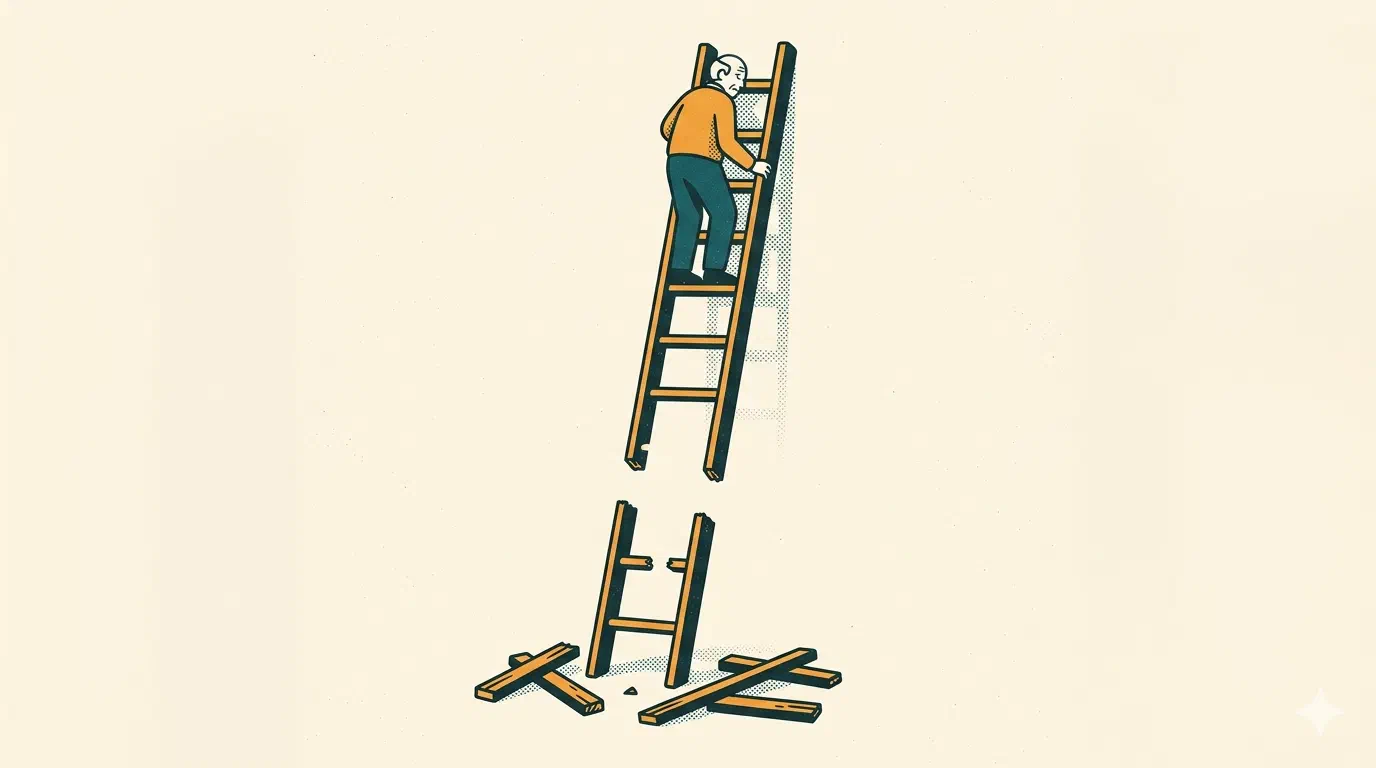
Here’s the line the spreadsheet leaves off. The grindy work a junior used to cut their teeth on, the small fixes, the boring migrations, the read-the-stack-trace-and-figure-it-out, is exactly the work AI now does. So the proving ground is gone. And the entry-level seats where they’d have stood on it are the ones being cut. Squeezed from both ends at once: no reps, and nowhere to take them.
Russinovich and Hanselman put the consequence plainly. Without early-career hiring the talent pipeline collapses, and you arrive at a future with no next generation of experienced engineers. The seniors you’ll be desperate for in 2032 are the juniors you declined to train in 2026. The bill doesn’t vanish. It just falls due long after the people who cut the cheque have moved on.
How to manufacture a world of AI slop
I named the last piece for its villain; let me name this one’s too. Raise a generation that can produce with AI but was never taught to validate, and here is what you get: people shipping machine-built products at speed with no instinct for where the output is quietly wrong, because they never had to be wrong the slow way first. Software nobody genuinely understands, human-written and AI-written alike, and a steady leak of trust out of all of it.
That isn’t a productivity problem. That’s a world of AI slop, and not in one project’s inbox this time but everywhere at once. We’d have automated our way clean out of the one job AI cannot do for us: knowing when not to trust the machine.
It’s a choice, and it’s yours
Andrew Murphy put it with more bite than I’d quite dare: AI didn’t kill your junior pipeline, you did. He’s right. This isn’t weather. Nobody is making you do it. It’s a decision, taken quarter by quarter, and a decision is a thing you can take differently.
The fix isn’t complicated, it’s just unfashionable. Keep hiring early-career engineers. Say out loud that they cost you capacity at first, and treat their growth as an actual goal rather than something meant to happen by osmosis. Russinovich and Hanselman call it preceptorship at scale: senior mentorship, deliberately structured, turning the ordinary day’s work into teachable moments.
And the proving ground can be rebuilt, just not where it stood. If AI does the writing now, the apprenticeship moves to the reviewing. Put juniors in the loop on the machine’s output and have them hunt for the subtle wrongness, the way a scanner is an argument, not an order. That’s how judgement gets built now: not by grinding out the work, but by verifying it. Which, as luck would have it, is the single most valuable thing anyone on your team can learn to do.
The part that’s on the greybeards
This is where I stop letting the companies wear all the blame, because some of it is mine, and yours. Verification is a craft, and crafts pass from person to person or not at all. I know where every one of my own AI misfires comes from: I gave it too little context, or too much rope, and didn’t check the result closely enough. The tool rarely went rogue. The gap was always my diligence. That’s not a confession, it’s the curriculum, and it’s precisely the judgement a junior can only earn by sitting in the loop beside someone who has already made those mistakes.
So the senior engineer’s job has quietly changed underneath us. It was never really the typing. It was knowing when something is off, and what the customer actually needs, and now it is also handing that on, deliberately, while there’s still time to. Mentor and guardian first; fastest prompt in the room a distant second.
The ladder you’re standing on
There will always be something AI can’t do well enough, and for a good while yet it’s the thing that matters most: being the accountable human who genuinely understands what’s needed and can be held to it when it goes wrong. A simulation can be enormously convincing. It cannot be responsible.
Which brings me back to my cabin. I do want it one day, the trees and the woodstove and the blissful disconnection. But I only get to go if the work outlives me, and the work only outlives me if the people do. So the last useful thing my generation does, before we shuffle off to find our trees, isn’t shipping a little more code. It’s making sure there’s somebody left who can tell when the machine is wrong. Pull the ladder up behind us and there’ll be nobody to notice the rot, and no cabin quiet enough to make that sit right.