 Soapbox
I was in a job interview yesterday, on the wrong side of the desk for once. After years of being the one asking the questions I’m having a look at what’s next, and somewhere in a long, wandering technical conversation the inevitable arrived: where do I think AI is going, and what does it mean for how we build software?
I gave my answer. You can probably guess most of it. The more interesting thing was the question I’ve started asking them back. Not the salary, not the stack. What is your actual position on AI, and how are you building a team out of both its human and its non-human parts? I ask the company and I ask the interviewer personally, because the two answers are rarely the same, and because I’ve decided I can’t work somewhere that hasn’t sat with the question properly.
Here is why it has become my litmus test.
The rung, and who’s standing on it
I wrote recently that the greybeards’ edge was never typing: agentic tools give a senior a boost because they have the judgement to steer and verify, and give a junior a drag because they don’t have it yet and the machine hands them more rope than they can hold. The cold incentive that falls out is to hire seniors and automate the juniors.
The data has since caught up with the worry. Entry-level software postings have fallen by something like 40% from their 2022 peak. The share of juniors and graduates in IT employment has dropped from roughly 15% to 7% in three years, and Stanford researchers tracking early-career workers in AI-exposed jobs found the youngest cohort down sharply from its peak. The numbers are genuinely grim, and plenty of people are putting it bluntly: the industry killed the junior on purpose.
That framing is half right, and I think it’s worth getting the other half right too.
It was never about efficiency. It was about cost.
We didn’t automate the junior because the work needed doing better. We did it because people are expensive. We need sleep, we draw a salary, and our thinking takes time and effort that a quarterly target can’t see the point of. AI got sold as round-the-clock labour with none of that overhead, and to a business that is an almost irresistible line on a spreadsheet. There’s a grim irony arriving, mind: the bills are starting to land, and the same conversations that hyped the cheap labour are now quietly working out that all those tokens aren’t cheap at all.
Step back, though, and none of this is new. Man finds a shortcut, man takes a shortcut. From the industrial revolution onward, every time we found a way to get more done with less human effort we took it, and the work reshaped itself around the new tools. We are still here, still employed, just doing different things than our great-grandparents did.
What is genuinely new is what we’re automating. Every technological advance before this one automated the machinery of the body, the muscle and sinew and bone. This is the first time we have automated thinking, and that is a modern marvel, something we should be proud of as a species. The problem isn’t the marvel. It’s the rate. AI is improving faster than we can adapt to it, and adaptation is the entire game.
So where does the blame sit? Not on one logo. No single company did this, however easy Meta or Google make it to point at the latest round of cuts. Society did, our collective and very human hunger to build bigger and faster. That makes it harder to fix, because there is no villain to regulate, only ourselves to out-think.
The bit that should frighten you
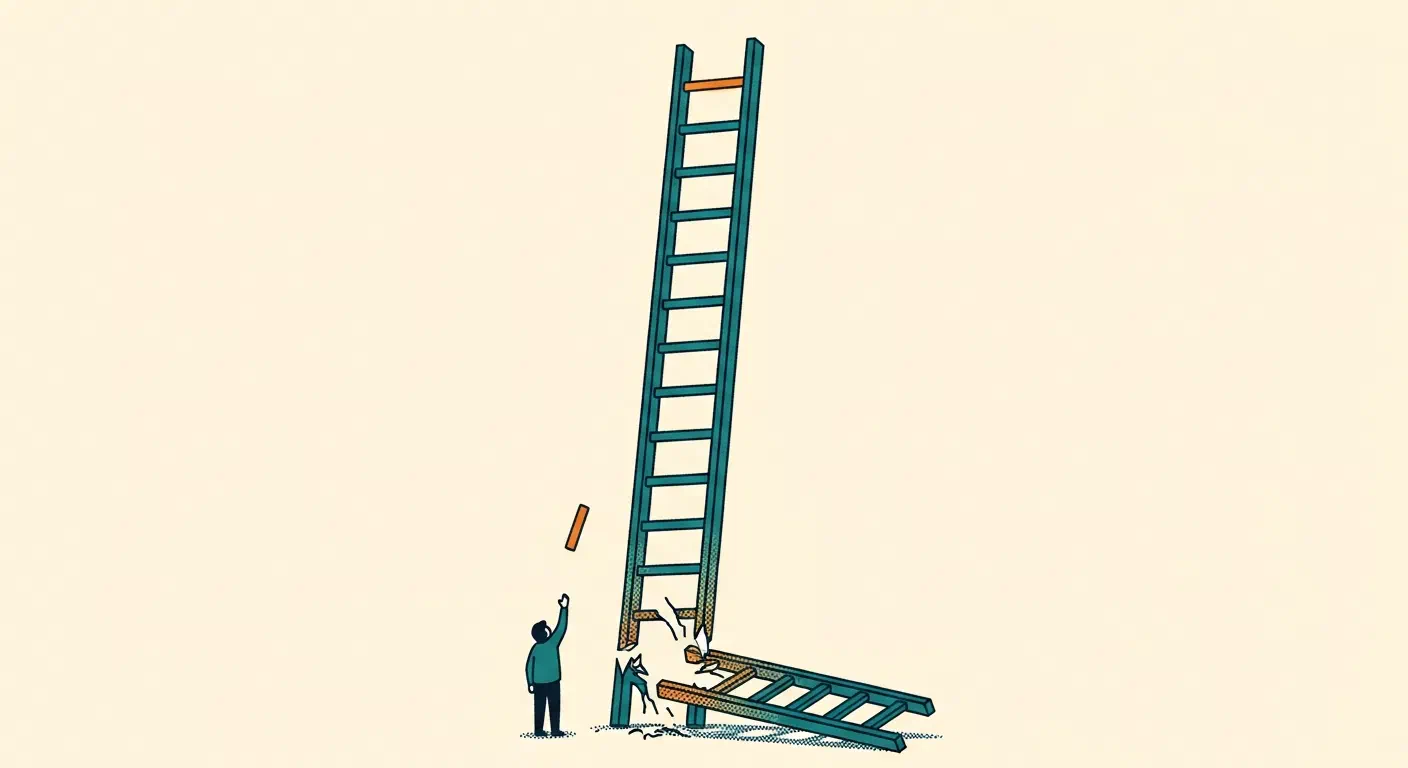
Cutting the junior intake isn’t a saving. It’s occupational suicide.
A junior is not cheap labour that AI happens to have made cheaper. A junior is a senior who hasn’t happened yet. Saw off the bottom rung and for a good while nothing bad happens… because you’ve still got your seniors holding everything up. Then the greybeards retire, and I have a cabin and a woodstove with my name on it for exactly that day, and the role that used to grow their replacements has been hollowed out for a decade, and there is simply nobody left who learned to tell when the machine is wrong. That isn’t a hiring problem. It’s an existential one, and you can’t fix it retroactively.
It starts before the first job, too. We teach primary-school children the basics of programming in this country, which is a wonderful thing, except the curriculum was written for a world without AI in the room, and by the time those children reach secondary school a good deal of it will be teaching a craft that has already moved on. We’re throttling the pipeline at both ends at once: hollowing out the entry-level job, and feeding it from a school system running a step behind.
It’s a split, not a collapse
The counterweight to the doom is that none of this is uniform, and the loudest version, “the junior is dead”, simply isn’t true. IBM just tripled its US entry-level hiring while most of the industry was cutting, and its HR chief said the quiet part out loud: AI can handle most of the routine entry-level tasks now, the work still needs a human, and the companies that double down on early-career hiring in this environment are the ones that win in three to five years. They didn’t keep the junior role as it was. They rewrote it, less boilerplate, more time spent with customers and supervising what the AI produced.
That is the shape of the thing. The juniors who are thriving in 2026 aren’t the fastest typists. They’re the ones building judgement, which is precisely the edge I argued was the senior’s real value all along. The market hasn’t stopped wanting juniors, it’s stopped wanting the version of the junior whose job was the work AI now does.
Day zero
So what does a junior actually look like now? I don’t know yet… and anyone telling you they’ve got it worked out is selling something. We are at day zero of this.
The junior gauntlet, the rite of passage every one of us runs to earn our stripes, isn’t going anywhere. Doing your time is a cold fact of the craft and it always will be. What changes is what the gauntlet contains, and that will keep changing, day one, day two, day five hundred and twelve. The only way we redefine it well is to put juniors and seniors on it together, with the AI in the room from the start instead of bolted on afterwards. Bring it closer to our people, and bring it earlier.
Open the floodgates, in other words. Let engineers of every creed and calibre in, and let them evolve with the machine, because that is the only way the symbiosis everyone keeps promising actually happens. Darwin’s line was survival of the fittest, and fitness here means adapting alongside the tool, not being spared by it. Choke off the flow of the very people who could do that adapting, and we don’t get fitter. We go extinct.
The end I’m holding
Which is the long way back to that interview. I keep asking the question, what is your real position on AI and how are you building a team of people and machines together, because the answer tells me whether a company is optimising for this quarter or for the survival of the craft. I want to work where it’s the second one, and I think any engineer sitting across that desk should be asking the same.
And it’s why, whatever desk I land at, there’s one thing I already know I’ll do. I don’t have the map. Nobody does. But every junior who works under me is going to get the chance to run the gauntlet, to grow into a senior, and to be in the room while we work out what the next gauntlet should even be. That isn’t charity. It’s the only sane investment any of us can make. The last properly useful thing my generation does, before we go and find our cabins, is make sure there’s somebody left to hand the thread to. I intend to be holding my end of it.